On coffee packs you will often see labels such as "light", "medium" or "dark roast". These are not mere technical details: the roast level is one of the factors that most shapes what you taste in the cup, sometimes even more than the bean's origin. You do not need to know a roaster's secrets to choose well; you just need to know what to expect from each level and which one comes closest to your taste and the way you make your coffee. Let us look at them together.
Light roast: coffee that tells the story of its origin
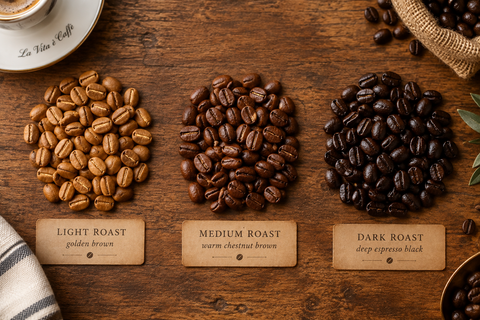
A light-roast coffee is hazelnut brown, with a dry, matt surface. In the cup it is lively, with a bright acidity and a light body. It is the roast that lets the character of the growing region shine through most clearly: floral, fruity and citrus notes, sometimes almost tea-like.
A typical example is our Ethiopia Yirgacheffe, a washed Arabica from indigenous varieties with aromas of flowers, citrus and honey. A light roast is the natural choice for this kind of coffee, because it preserves its delicacy.
- Who it suits: anyone who loves fresh, nuanced flavours, drinks coffee without sugar or milk, and wants to discover the differences between origins.
- Best methods: filter (V60, Chemex), French press, or even a "different" espresso, brighter and more fragrant.
- Worth knowing: if you are used to classic Italian espresso, the first sip may surprise you. Give it a few cups.
Medium roast: the balance
A medium roast is where the notes of origin meet those developed by roasting. The bean is an even brown and the flavour becomes rounder: acidity softens, sweetness grows, and hints of caramel, chocolate and nuts appear. The body is full but not heavy.
It is the most versatile profile and the one that pleases most people. Our Poesia blend was created in exactly this spirit: Central and South American Arabica, medium roasted, sweet and enveloping, with notes of dark chocolate, vanilla, toasted hazelnut and honey.
- Who it suits: anyone looking for a coffee for any time of day, equally pleasant black or with a touch of sugar.
- Best methods: espresso, moka, bean-to-cup machines, and filter too.
- Worth knowing: if you are not sure where to begin, begin here.
Dark roast: body and intensity
With a deeper roast the bean turns dark brown, sometimes with a slightly glossy surface. Acidity almost disappears and deeper notes take over: bitter cocoa, spice, roastiness. The body is full, the espresso crema thick and long-lasting, the flavour bold.
This is the profile of many traditional Italian espressos, especially in the south. Our Gran Crema, with a medium-dark roast and an intensity of 8 out of 10, combines Central and South American Arabica with Asian Robusta for a full-bodied cup with notes of oriental spices, chocolate and nuts.
- Who it suits: anyone who loves an intense coffee, or drinks it with milk (cappuccino, latte macchiato), where it holds its own.
- Best methods: espresso and moka.
- Worth knowing: darker does not mean "stronger" in caffeine. The intensity you perceive is mainly a matter of flavour and body.
How to choose: three questions to ask yourself
To find your way, try answering these questions.
- How do you drink your coffee? If you take it with milk, a medium or medium-dark roast works better, because the flavour is not lost. If you drink it black and unsweetened, you can be bolder with light roasts.
- Which method do you use? Espresso and moka bring out the best in medium and dark roasts; filter methods highlight light ones.
- What do you like in general? If you love dark chocolate and toasty flavours, look towards darker roasts. If you prefer fresh fruit, fragrant teas or an aromatic white wine, light roasts may surprise you.
There is no single "best" roast, only the right one for you, and perhaps more than one depending on the time of day. Many coffee lovers keep a full-bodied coffee for breakfast and a more delicate one for the afternoon.
Our approach
At our artisan roastery in the Langhe, in business since 1979, every single origin is roasted separately, so that we can find for each one the point at which it best expresses its character. After roasting, the beans are sorted by hand. It is slow work, but it allows us to offer you distinct, recognisable profiles, from the delicacy of a specialty coffee to the body of a classic espresso.
The best way to find out which roast suits you is to taste more than one, ideally side by side. Pick two or three different profiles and compare them at your leisure: your palate will tell you the rest.